Applied & Classical ML · entry 06/06 · 3 min read
ML for science
Protein structure, weather and materials — what actually changed, what the pattern behind the wins is, and what 'AI solved it' leaves out.
The result that changed expectations
Protein structure prediction was a fifty-year open problem: given an amino-acid sequence, what shape does it fold into? In 2020 a deep learning system reached backbone accuracy comparable to experimental methods on a large fraction of targets in the field's blind assessment, and a public database of predicted structures followed. It is the clearest case yet of machine learning producing something scientists use as infrastructure rather than as a demonstration. In 2024 half the Nobel Prize in Chemistry went to Demis Hassabis and John Jumper for it, the other half to David Baker for the inverse problem — designing proteins that fold to order.
The pattern behind the wins
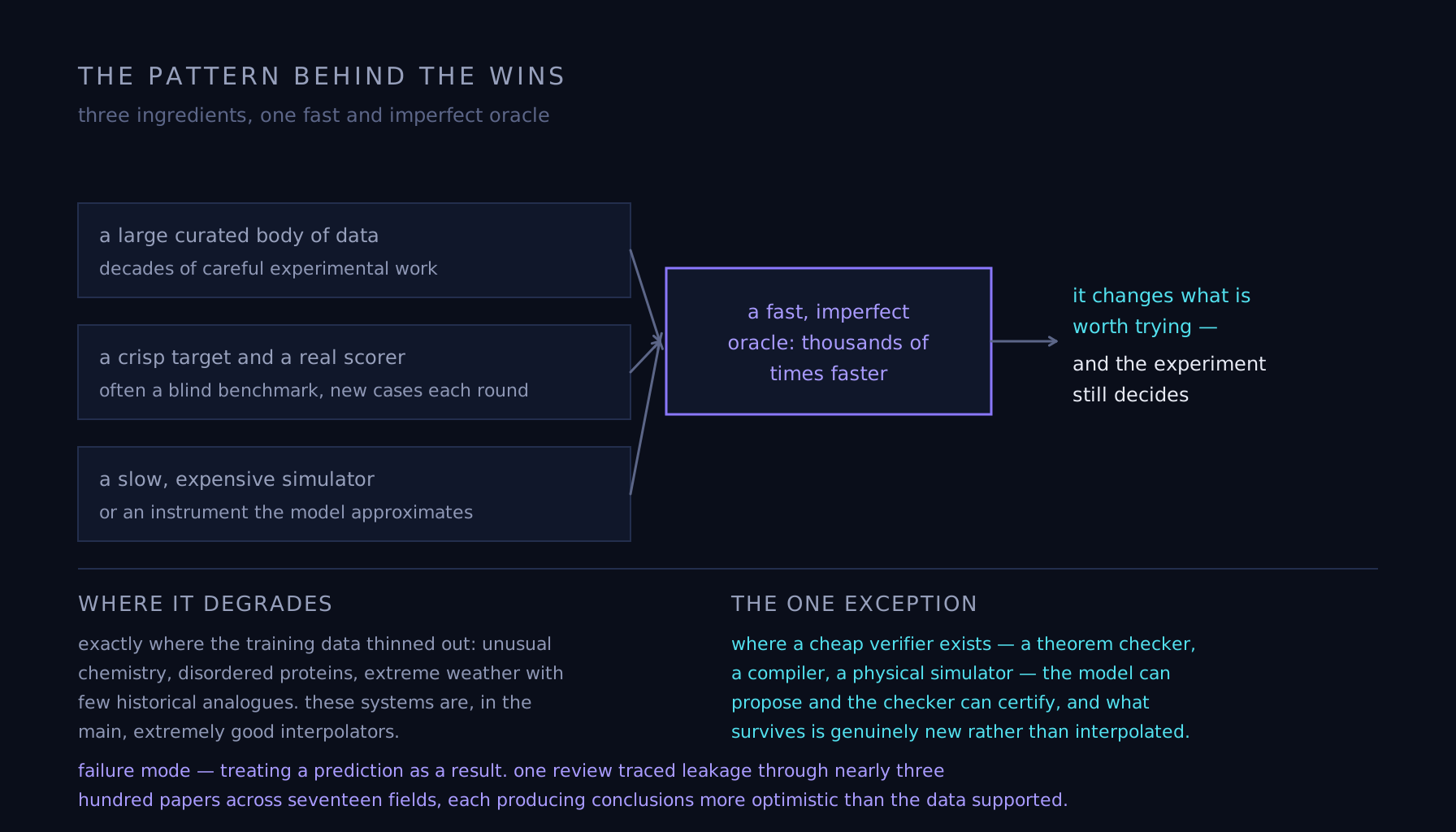
The scientific successes share a recognizable setup. There is a large, curated body of data produced by decades of careful experimental work — structures, weather reanalyses, materials databases. The target has a crisp definition and a real scorer, often a long-running community benchmark that nobody can game because the test cases are new each round. And a slow, expensive simulator or instrument exists, which the learned model approximates thousands of times faster. That combination — real data, honest evaluation, an expensive baseline to accelerate — describes weather forecasting, where learned models now match or beat operational numerical systems on medium-range temperature, wind and pressure at a small fraction of the forecast compute. Note the scoping. They still take their initial conditions from the numerical system's data assimilation, which is the expensive half of the pipeline; they remain weaker on precipitation; and physics models still beat them on record-breaking extremes, for exactly the reason below. The same shape describes materials screening and computational chemistry.
What the model is and is not doing
These systems are, in the main, extremely good interpolators over a well-sampled space. That is enormously valuable — it turns a month-long experiment into an afternoon and lets a researcher triage ten thousand candidates instead of ten. It is not the same as understanding the mechanism, and it degrades exactly where the training data thinned out: unusual chemistry, disordered proteins, extreme weather with few historical analogues. The honest description is a fast, imperfect oracle that changes what is worth trying, and the experiment still decides. One family sits outside this description: where a cheap verifier exists — a theorem checker, a compiler, a physical simulator — the model can propose and the checker can certify, and what survives is genuinely new rather than interpolated.
Failure mode
Treating a prediction as a result. A predicted structure, a screened material, a proposed reaction is a hypothesis with a confidence attached, and the confidence is only as good as its calibration on cases like this one. The scientific literature is already accumulating results that did not replicate because a model's output was reported as a finding — one review traced leakage through nearly three hundred papers across seventeen fields, each producing conclusions more optimistic than the data supported. The discipline that makes this work is old and unchanged: a held-out benchmark nobody trained on, uncertainty reported alongside every number, and wet-lab confirmation before anything is claimed.