section 05 · status: live · 8 entries · updated 2026-08-29
AI Agents
The current frontier of applied AI: models given tools, memory and a goal, running in a loop. What an agent really is, how it calls tools and drives software, what it remembers, when many agents beat one, and how to evaluate systems that act rather than answer.
live · the agent loop — reason, act, observe, repeat
- What makes an agent3 mina model in a loop with consequences
- Tool use & function calling3 minthe model asks, your code acts
- MCP: a standard for tools3 minone protocol between models and everything
- Computer use3 minwhen the tool is the whole screen
- Agent memory3 mineverything it knows tomorrow, you had to write down
- Multi-agent systems3 mina team of models, at a price
- Coding agents3 minthe application where the loop actually closed
- Evaluating & containing agents3 mintrust the state, not the summary
check yourselfAnswer before you open
Trying to recall something teaches it better than re-reading does. Have a go, then open the answer.
An agent completes each step correctly 95% of the time. How often does a twenty-step task succeed?
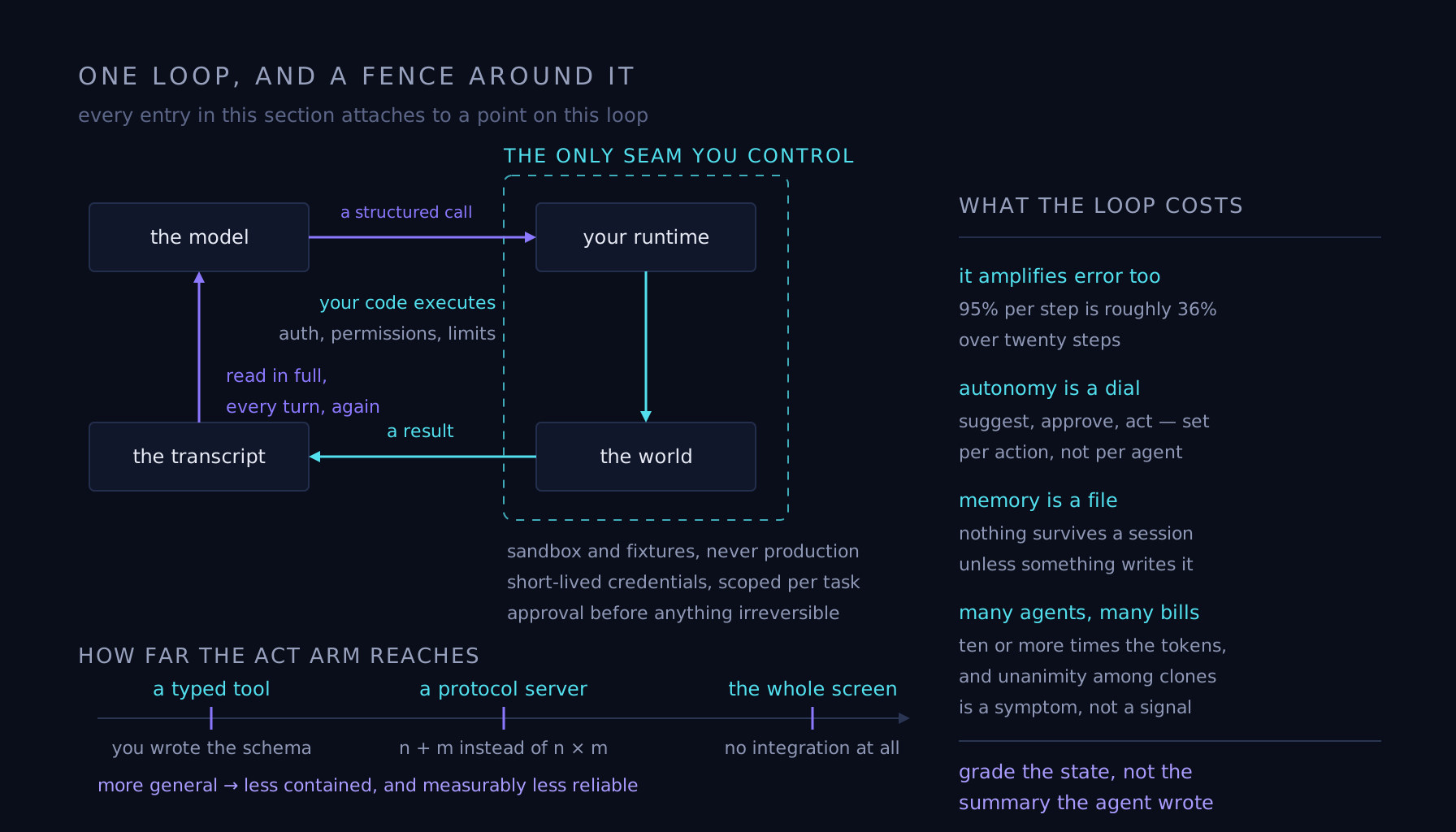
About 36%, if the steps are independent — 0.95 to the twentieth. The loop multiplies error as readily as capability, which is why agents need brakes rather than better manners. What makes an agent →
Your agent reads webpages and can send email. What is the risk?
A page can contain instructions the model follows — prompt injection — and the send tool turns that into exfiltration. Nothing filters this away reliably; the layer with teeth is architectural — least privilege, scoped credentials, and keeping reads-untrusted-content separate from acts-with-secrets. Jailbreaks & prompt injection →
An agent reports 'Done — all tests pass.' Why is that not evidence?
Because the summary is model output too, subject to the same failure as everything else it writes. Evaluate the world, not the story: query the database, run the tests yourself, check the file exists. Evaluating & containing agents →
Your agent has 40 tools and keeps picking the wrong one. What is the most likely fix?
Fewer, sharper tools. Every schema occupies context, and overlapping tools dilute the choice — the model picks the almost-right one and fails oddly. Tool design is prompt engineering with a compiler: if a human skimming the list cannot predict which tool fits a job, neither can the model. Tool use & function calling →
An agent has been running for two hours and its context is full. What are your options, and what does each cost?
Compact — summarize the history, losing detail you cannot get back. Externalize — write findings to files and re-read on demand, paying latency and risking stale reads. Restart with a handoff note, losing implicit context. There is no free option; the craft is choosing what to lose deliberately rather than by truncation. Agent memory →
You mount two MCP servers that were each safe on their own and the combination exfiltrates data. What went wrong in the review?
It reviewed servers instead of combinations. One server reads untrusted content, the other holds a credential and can send — neither is dangerous alone, and together they are the whole attack. Audit the set mounted per session, and re-audit whenever it changes. MCP: a standard for tools →