section 02 · status: live · 6 entries · updated 2026-08-29
Applied & Classical ML
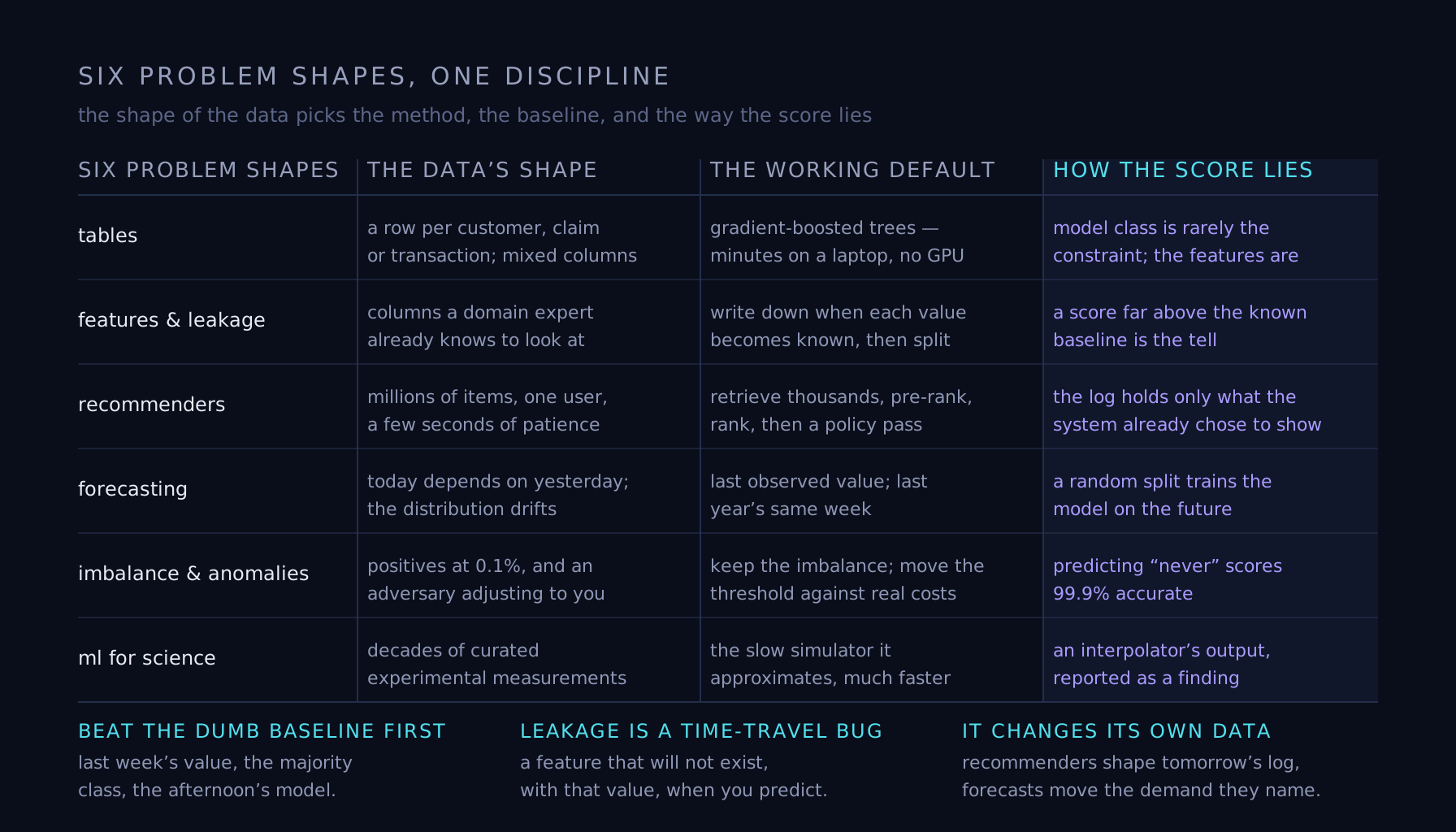
Behind the headlines, most deployed machine learning reads rows and columns and answers a business question. Why trees still beat networks on tables, the feature work that decides everything, recommenders, forecasting, rare-event detection, and the scientific results that changed what any of this is for.
live · gradient boosting — each tree fits what the last one missed
- Tables still rule3 minthe models that run the world are not transformers
- Features & leakage3 minthe bug that makes your model look brilliant
- Recommender systems3 minretrieve thousands, trim to hundreds, rank, show ten
- Forecasting3 minthe future is a different distribution, on purpose
- Imbalance & anomalies3 minone in ten thousand, and the ten thousand keep changing
- ML for science3 minwhere prediction started producing discoveries
check yourselfAnswer before you open
Trying to recall something teaches it better than re-reading does. Have a go, then open the answer.
Your churn model gets AUC 0.98 on validation. What is your first reaction?
Suspicion. On real business data that number usually means leakage — a feature that is only populated after the outcome, a scaler fitted before the split, or the same customer in both train and test. Find the top feature by importance and ask when its value is actually written, relative to when the prediction has to be made. Features & leakage →
You have a table of 200,000 rows and 60 mixed columns. Where do you start?
A gradient-boosted tree. It is the production default and hard to beat: no normalization needed, thresholds match how business relationships actually behave, missing values carry information, and it trains in minutes on a laptop. Pretrained tabular foundation models now contest that on smaller tables; reach for a network when a column has structure inside it — long text, an image, a sequence. Tables still rule →
Why can't a recommender score every item for every request?
There are millions of items and a few dozen milliseconds. So production systems split the job: cheap retrieval narrows the catalog to a few hundred candidates, then an expensive ranker scores only those. Almost every recommendation you have ever seen came out of that two-stage shape. Recommender systems →
Your demand forecast beats last year's model by 3%. What should you check first?
Whether it beats the naive baseline — last value, last year's same week, a rolling mean. On a single short series, simple statistical methods are still very hard to beat, and a model that cannot clear 'same as last week' has not earned a deployment no matter what else it beats. Across thousands of related series the picture flips: M5 was swept by boosted trees. Forecasting →
Fraud is 0.1% of transactions and your detector has 99.9% accuracy. What have you learned?
Nothing — predicting 'never fraud' scores exactly that. Under extreme imbalance you need precision and recall, and the threshold has to come from the cost of both errors: every false positive freezes a real customer's card, and a detector nobody trusts is a queue nobody works. Imbalance & anomalies →