section 15 · status: live · 6 entries · updated 2026-08-29
History of AI
The field that named itself at a summer workshop, died twice by its own promises, rebuilt itself as statistics, and detonated when three quiet ingredients finally met. Not nostalgia — a pattern library for reading the present.
live · seventy years swept in fifteen seconds — booms, winters, detonation
- The founding dream3 mina summer workshop names a field and mortgages its credibility
- Winters & thaws2 mintwice the field promised, twice the funding froze
- The quiet decades2 minstatistics, GPUs, and a million labeled images
- The deep-learning decade2 minfrom AlexNet to ChatGPT in ten compounding years
- The open-weights turn3 minthe release that split the field into two ecosystems
- Reading the present3 minusing seventy years of pattern to see this moment clearly
check yourselfAnswer before you open
Trying to recall something teaches it better than re-reading does. Have a go, then open the answer.
What actually caused the AI winters?
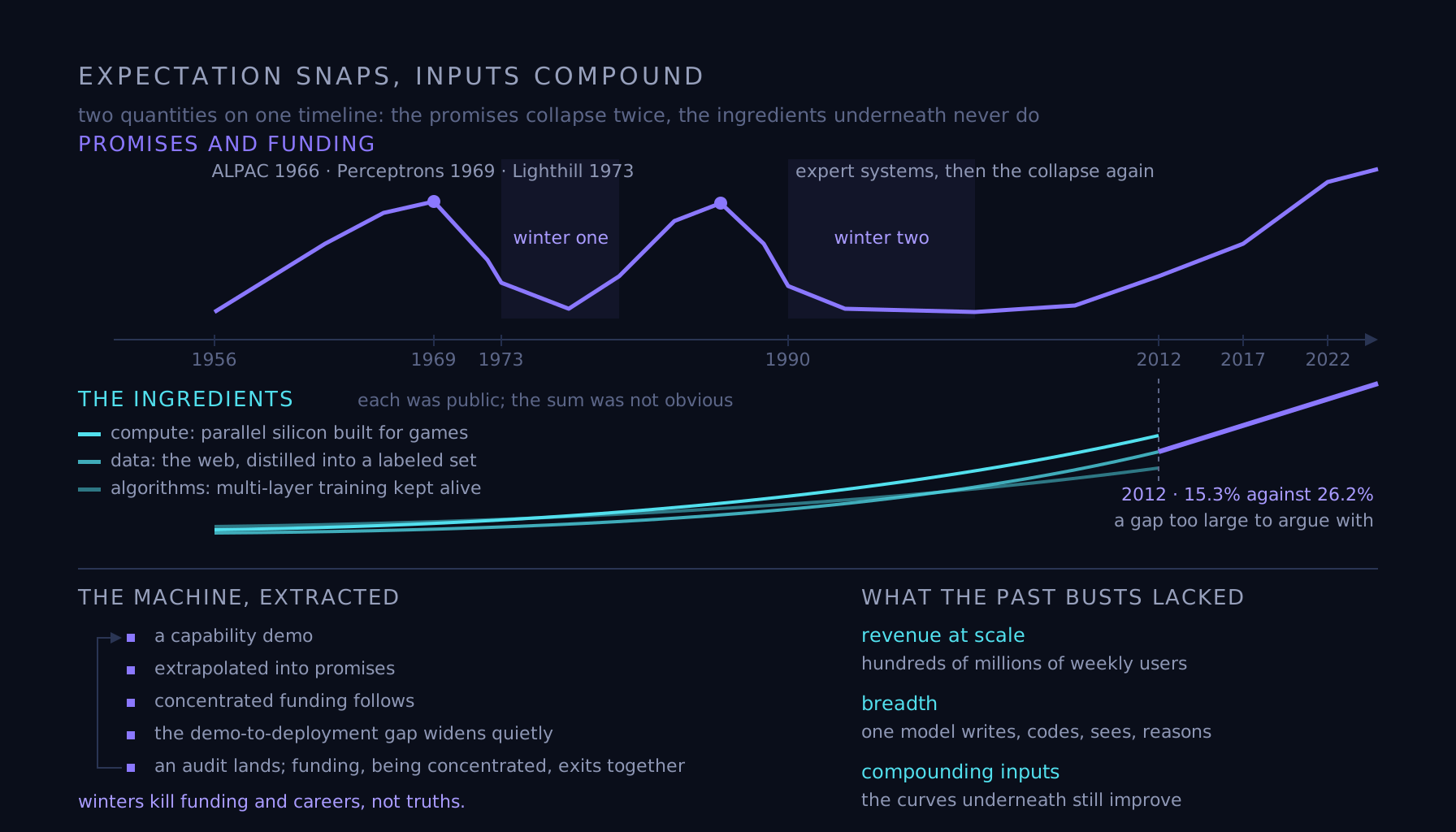
A repeating mechanism, not a refutation: demos generate extrapolated promises, concentrated funding follows, the demo-to-deployment gap accumulates quietly, an audit or market event snaps expectations to evidence, and concentrated funding exits together. Neural networks were 'refuted' in 1969 and run the world now. Winters & thaws →
Three ingredients met in 2012. What were they, and why is that the lesson?
GPUs from the gaming industry, ImageNet's million labeled images, and algorithms a small community kept refining through the unfashionable years. All three were public; the sum was not obvious. Revolutions assemble from unglamorous parts, and the tell is a benchmark gap too large to argue with. The quiet decades →
Is this moment a bubble?
The wrong question, and the site refuses to answer it for you. Run the mechanism: how large is the demo-to-deployment gap, how concentrated is the funding, how much is revenue versus expectation, and are the input curves still improving? Reasonable people disagree — but they should be disagreeing about measurements. Reading the present →
Why did the founders' 1956 optimism turn out to be a liability?
Because the conjecture that intelligence can be precisely described was productive, and the timelines attached to it were not. Promising human-level performance within a generation set the terms by which the field was later judged — and funding was withdrawn against those promises, not against the science. The founding dream →
What actually caused the deep-learning breakthrough of the 2010s?
Three long-running curves finally meeting: enough labeled data, cheap parallel compute in GPUs, and a stack of practical training tricks. The core ideas were decades old. That is the pattern worth carrying forward — the bottleneck is usually an input, not an insight. The deep-learning decade →