History of AI · entry 01/06 · 3 min read
The founding dream
Between 1943 and 1956, a handful of papers and one optimistic workshop defined artificial intelligence — its goals, its two rival instincts, and its habit of promising decades of work by Christmas.
Before the name
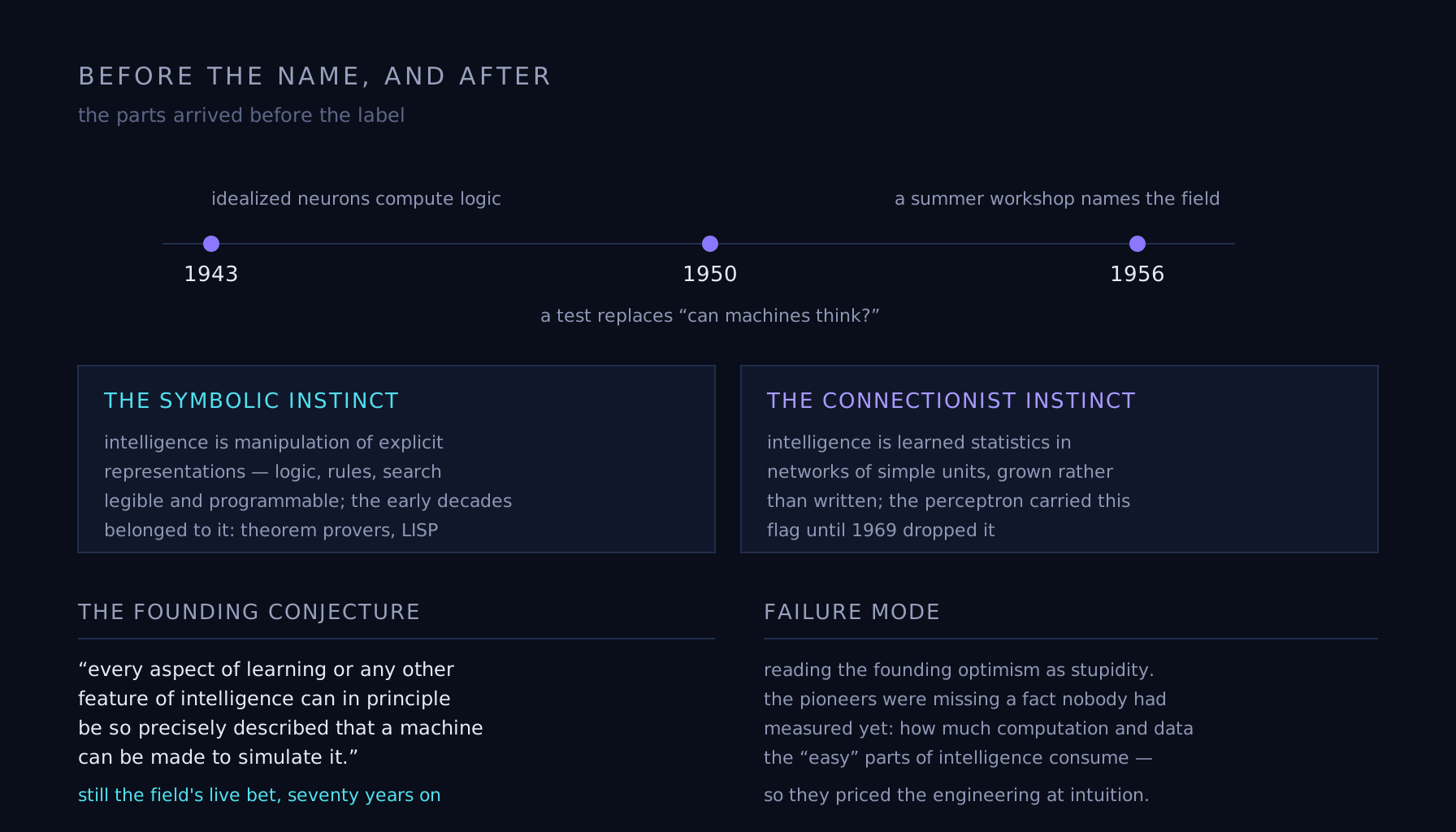
The field's parts arrived before its label. McCulloch and Pitts (1943) showed idealized neurons could compute logic — the first hint that thinking might be circuitry. Turing (1950) asked "can machines think?" and, finding the question hopeless, replaced it with a test: if conversation with the machine is indistinguishable from conversation with a person, what exactly is missing? He also predicted machines would learn like children rather than arrive assembled — the essay aged better than almost everything written after it. Shannon's information theory, cybernetics, and the first stored-program computers supplied the rest of the toolkit.
Dartmouth, 1956
The founding document is a funding proposal: John McCarthy, Marvin Minsky, Claude Shannon and Nathaniel Rochester proposed a summer study at Dartmouth on the conjecture that "every aspect of learning or any other feature of intelligence can in principle be so precisely described that a machine can be made to simulate it." They requested ten researchers for two months and expected "a significant advance." The proposal named the field — McCarthy coined artificial intelligence in it, partly to escape cybernetics' orbit — and the workshop set its sociology: brilliant people, grand claims, and timelines off by a factor of ten. The conjecture itself remains the field's live bet, neither proven nor refuted seventy years on.
Two instincts, present from birth
The founders split along a fault line that still runs through the field. The symbolic instinct: intelligence is manipulation of explicit representations — logic, rules, search — legible and programmable. The connectionist instinct: intelligence is learned statistics in networks of simple units, grown rather than written. Early decades belonged overwhelmingly to symbols (theorem provers, game search, LISP); the perceptron carried the other flag until 1969 dropped it. Neither side knew it would take fifty years and a hardware accident to settle the first round.
What the founders got right
More than the timelines suggest. Search, planning, and game-tree reasoning became permanent tools. McCarthy's LISP shaped programming itself. The insistence that intelligence could be studied as computation — not philosophy — created the discipline. Even the overreach was productive: the promises recruited a generation and built the labs the eventual breakthroughs came from.
Failure mode
Reading the founding optimism as stupidity. The pioneers weren't fools; they were missing a fact nobody had measured yet — how much computation and data the "easy" parts of intelligence consume, the lesson Moravec later named. Their error pattern is the field's permanent occupational hazard: correctly seeing that something is possible in principle, then pricing the engineering at intuition instead of at evidence. Every generation since has repeated it about something.