section 09 · status: live · 6 entries · updated 2026-08-29
Speech & Audio
Audio went from the hardest interface to a nearly solved one in a decade. How sound becomes a picture models can read, why transcription got shockingly good, what voice synthesis and cloning changed, what else is in a recording besides words, and the racing clock every voice agent lives under.
live · a waveform folded into a spectrogram, then into words
- How machines hear3 minsound as a picture of frequencies over time
- Speech to text3 mintranscription got shockingly good — measure where it isn't
- Whose voice it hears2 minone average error rate, several different products
- Text to speech2 minvoices are now synthesized, cloned, and directed
- The voice loop2 minlisten, think, speak — under a second, interruptible
- Audio beyond speech2 minwho spoke, who is that, and what just broke
check yourselfAnswer before you open
Trying to recall something teaches it better than re-reading does. Have a go, then open the answer.
Your transcription system produces a fluent sentence during a silent passage. Why?
Trained on subtitle data, recognizers learned what subtitles do during silence and music. It is hallucination with an audio accent — gate it with voice-activity detection and segment confidence rather than trusting the transcript. Speech to text →
A caller's voice matches the enrolled voiceprint. Is that authentication?
Not on its own, not any more. Cloning works from seconds of reference audio, so voice is one signal in a bundle at best; any flow where a voice match alone moves money is legacy risk. Audio beyond speech →
Your voice agent gives excellent answers and users hang up. What do you measure?
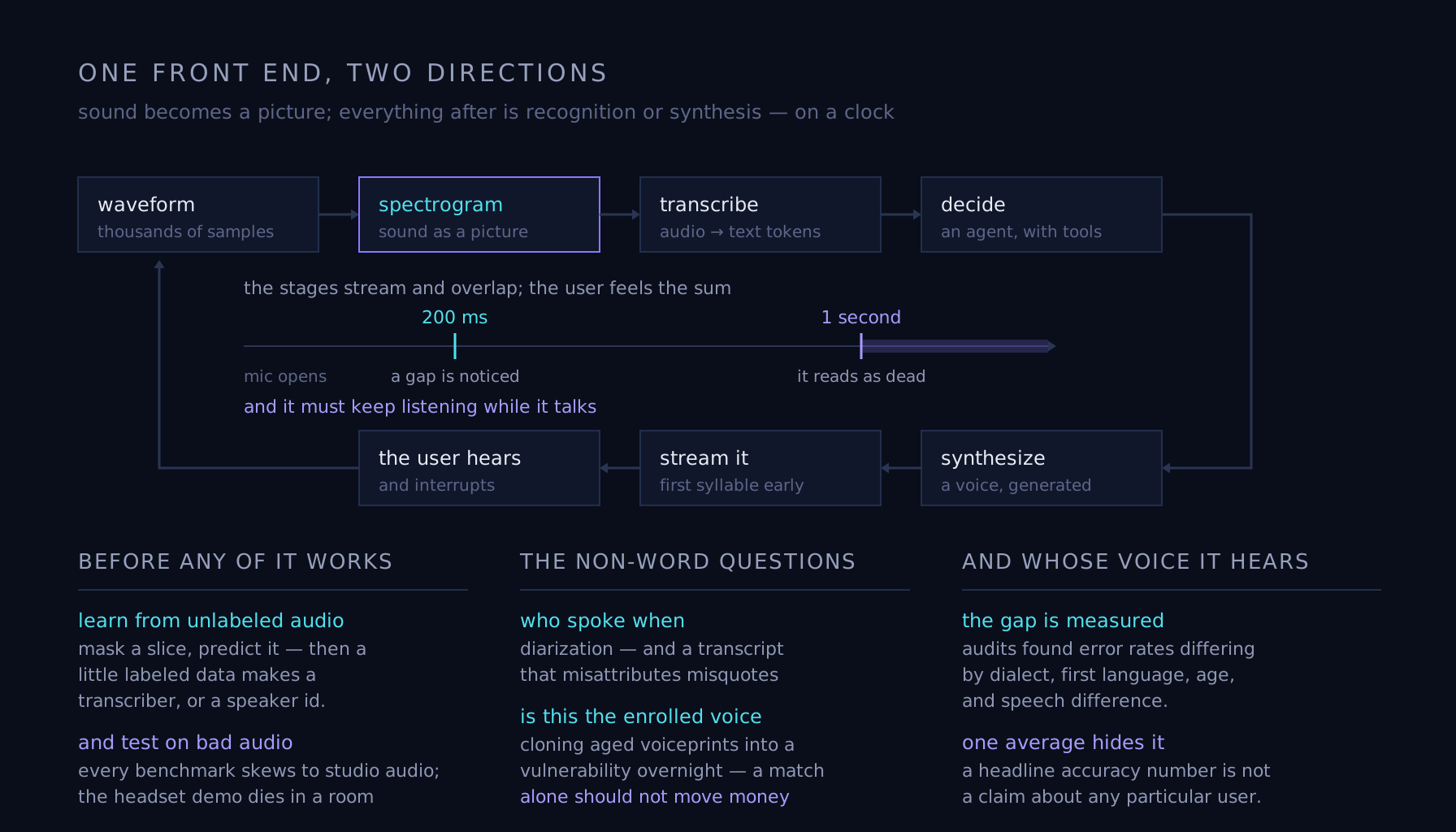
The full loop, microphone to first audible syllable. Humans notice a gap at around 200 milliseconds and give up past a second — past that point a smarter answer is just a slower failure. The voice loop →
Why does turning audio into a spectrogram help so much?
It converts a one-dimensional pressure wave into a two-dimensional picture of frequency over time — where phonemes, formants and noise become visible patterns. That reframing lets the whole vision toolkit apply, and it is roughly what the ear does before the signal reaches the brain. How machines hear →
Your synthesized voice is accurate but sounds wrong reading addresses and prices. Why?
Because the hard part of speech synthesis is not the voice, it is deciding what the text says out loud: '1/2' as a half or a date, '$1.5M' in words, where the emphasis lands in a question. Normalization and prosody carry the naturalness, and they fail exactly on the structured text products generate most. Text to speech →