section 12 · status: live · 6 entries · updated 2026-08-29
Robotics & Embodied AI
The world's harshest runtime: partial senses, unforgiving contact, no undo. Why embodiment stayed hard while chess fell, how the classical stack and learned policies divide the work, where the experience comes from, what manipulation and driving each demand, and what separates a demo reel from a shift of unattended work.
live · a two-link arm closing the loop on a target — shrugging off disturbances, slowing where it runs out of reach · optional sound
- Why robots are hard3 minchess fell in 1997; the doorknob still holds
- Sense, plan, act3 minthe classical stack, and the learning that's eating it
- Learning to move3 mindemonstrations, simulators, and internet-scale priors
- Manipulation & the humanoid bet2 minhands are the frontier; the body is a business case
- Self-driving3 minrobotics' biggest bet, graded on public streets
- Robots at work2 minwhere embodied AI already earns wages — and why pilots stall
check yourselfAnswer before you open
Trying to recall something teaches it better than re-reading does. Have a go, then open the answer.
Chess fell to machines in 1997. Why is folding a towel still hard?
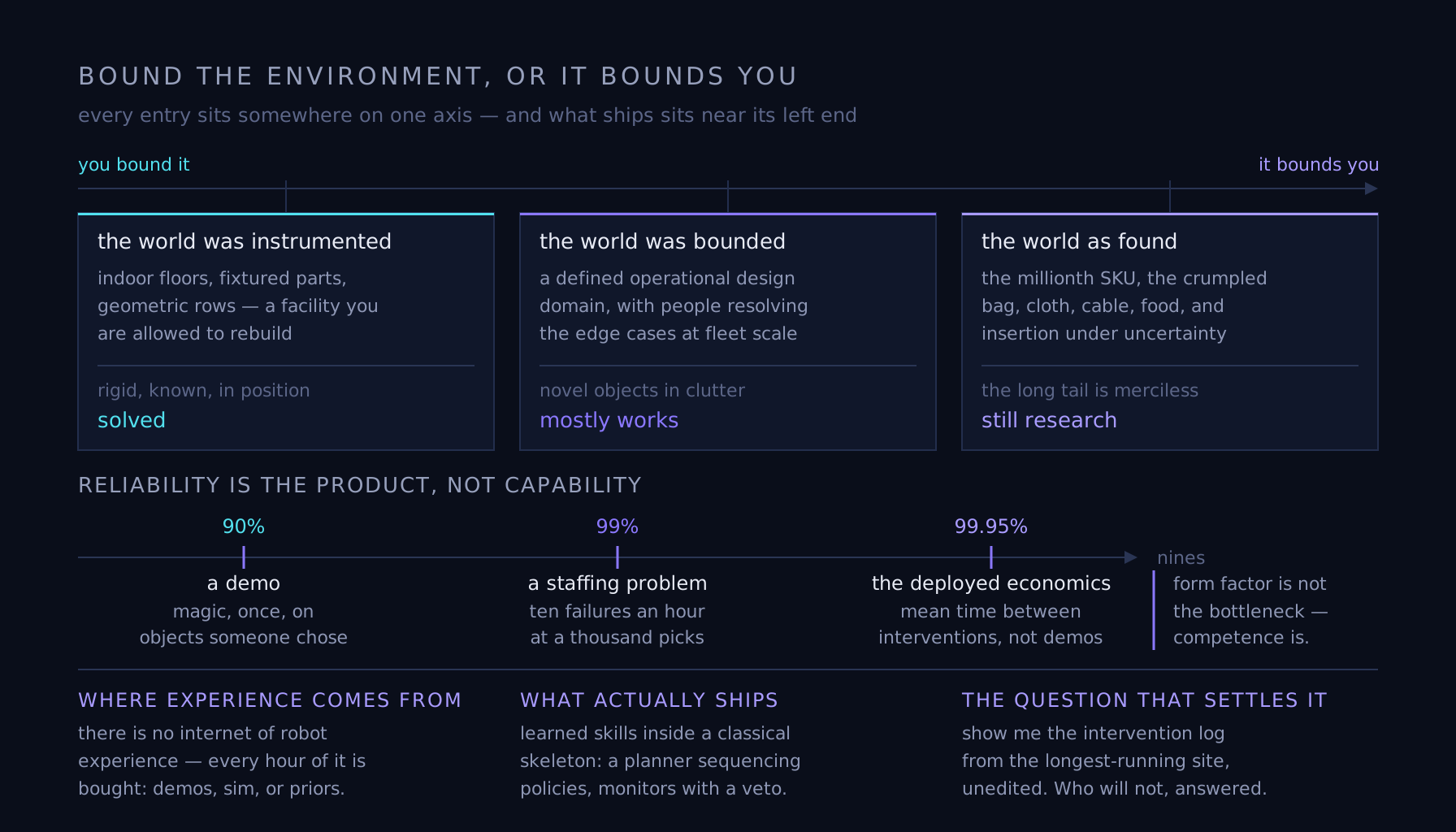
Moravec's paradox: skills humans acquire late are easy for machines, and the ones evolution spent hundreds of millions of years on are hard. Perception is partial, contact is discontinuous, and there is no undo. Why robots are hard →
A warehouse robot picks with 99% success. Why might that not be shippable?
At a thousand picks an hour, 99% is ten interventions an hour. Deployed economics live between 99% and 99.95%, in mean-time-between-interventions and in what happens after the failure. Robots at work →
What question cuts through any self-driving claim?
Who accepts liability when it is wrong, here, tonight, in the rain. The SAE level is not a capability score; it marks who is responsible at each instant — and if the answer is you, it is a driver-assistance product. Self-driving →
A robot's perception module reports the pallet at 94% confidence and the arm commits at full speed. What is the architectural error?
Uncertainty was thrown away at a layer boundary. Perception committed to a guess, planning treated it as fact, and the 6% happened at speed. Whatever the architecture, propagate uncertainty to the layer that can act on it: slow down, look again, widen the margin. Sense, plan, act →
Two teams report robot policies: one trained on 500 demonstrations, one on 50. Which is better?
Unanswerable from the counts. Coverage beats volume — fifty demos spanning lighting, positions, occlusions and recoveries beat five hundred takes of the same sunny-day grasp. Behavior cloning's classic flaw is that the demonstrator never shows recovery from states they never entered, so ask what fraction of the demos contain a mistake being corrected. Learning to move →