section 08 · status: live · 6 entries · updated 2026-08-29
Computer Vision
Sight was deep learning's first conquest and it never stopped shipping. How networks turn pixels into features, how detection and segmentation answer “where,” what vision-language models changed, what it takes to read a document or a video, and why the field's honest unit of measure is the camera nobody curated.
live · a 3×3 kernel sweeping the image, writing a feature map
- How machines see3 minfrom a grid of numbers to the idea of a cat
- Detection & segmentation2 minnot just what — where, how many, which pixels
- Vision-language models2 minpictures and words, one shared space
- Video understanding2 minpictures were easy; time is the hard part
- OCR & document AI2 minturning paper into data you can trust
- Vision in the wild2 minwhy the demo dies in the parking lot
check yourselfAnswer before you open
Trying to recall something teaches it better than re-reading does. Have a go, then open the answer.
A model classifies cows correctly in fields and fails on a beach. Why?
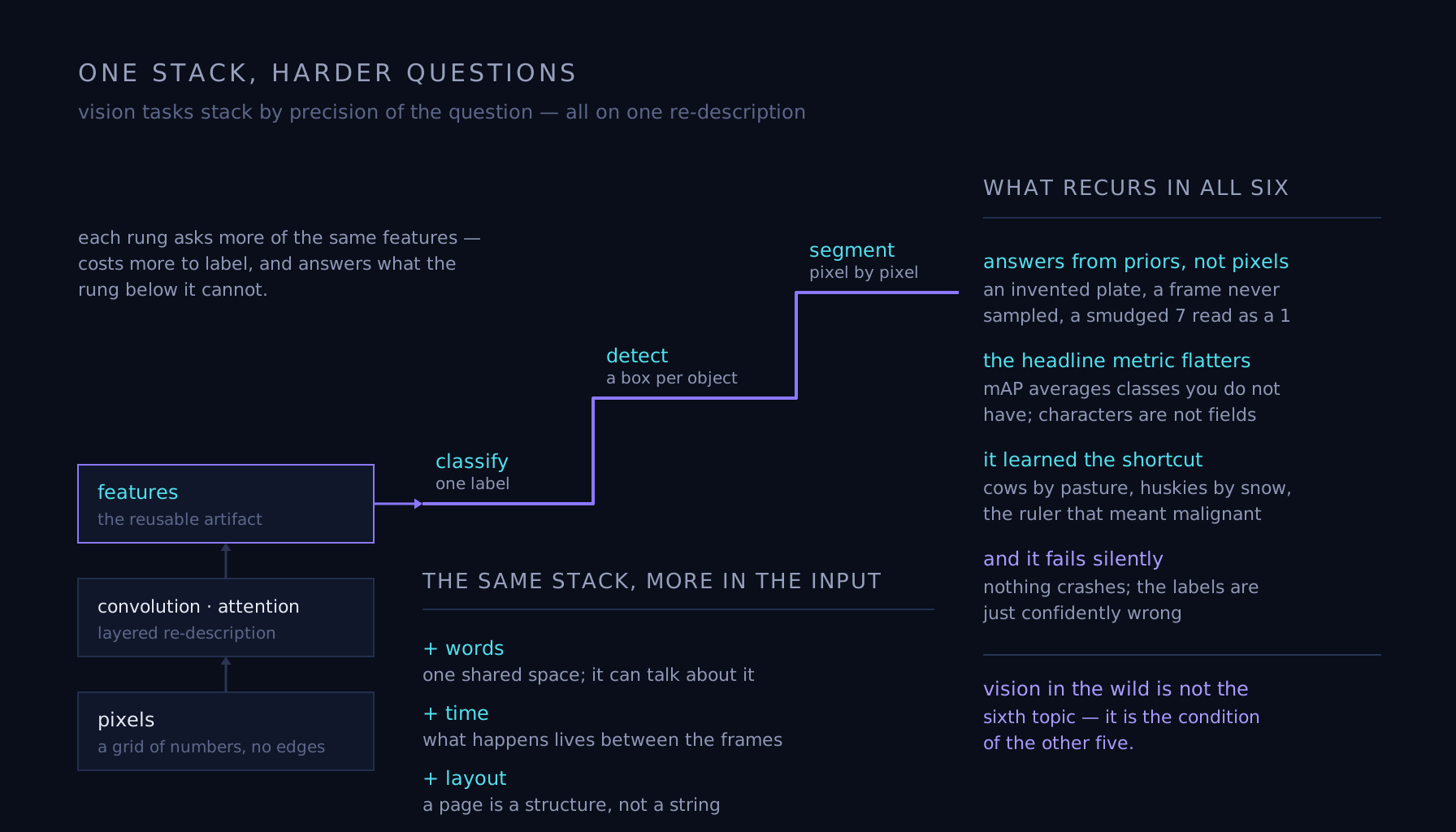
It learned the cheapest separator available — grass — rather than the concept. Shortcut learning is invisible while the correlation holds and obvious the day it breaks, which is why you spot-check on out-of-context examples before trusting a model anywhere important. Vision in the wild →
Your OCR vendor advertises 99% character accuracy. What should you measure instead?
Field accuracy on your own documents. At 99% per character, a ten-digit amount is wrong about one time in ten — and numbers carry no redundancy, so a misread digit does not look wrong in context. OCR & document AI →
A vision-language model describes a detail that isn't clearly visible. What is happening?
It is answering from priors about what such scenes usually contain, with the alibi of having looked. Check your pipeline's input resolution, crop and zoom before asking about detail, and allow 'not visible' as an answer. Vision-language models →
Why did convolutions work so much better than fully connected layers on images?
They build in what images actually are. A small filter slides across the whole picture, so a pattern learned in one corner is detected everywhere — that is equivariance, plus massive weight sharing. A dense layer would have to learn the same edge detector separately at every position, from far more data. How machines see →
A model answers questions about an hour-long video. What is it most likely doing, and where does that break?
Sampling frames — often a few per second or fewer — and reasoning over them plus any transcript. It breaks on anything between the sampled frames, on ordering and duration, and on questions needing continuous tracking. Treat confident answers about uncited moments as guesses; ask for timestamps and spot-check them. Video understanding →