Robotics & Embodied AI · entry 01/06 · 3 min read
Why robots are hard
AI mastered abstractions long before it could fold a towel — Moravec's paradox, the physics of contact, and why the real world is the harshest environment in computing.
The paradox that named the problem
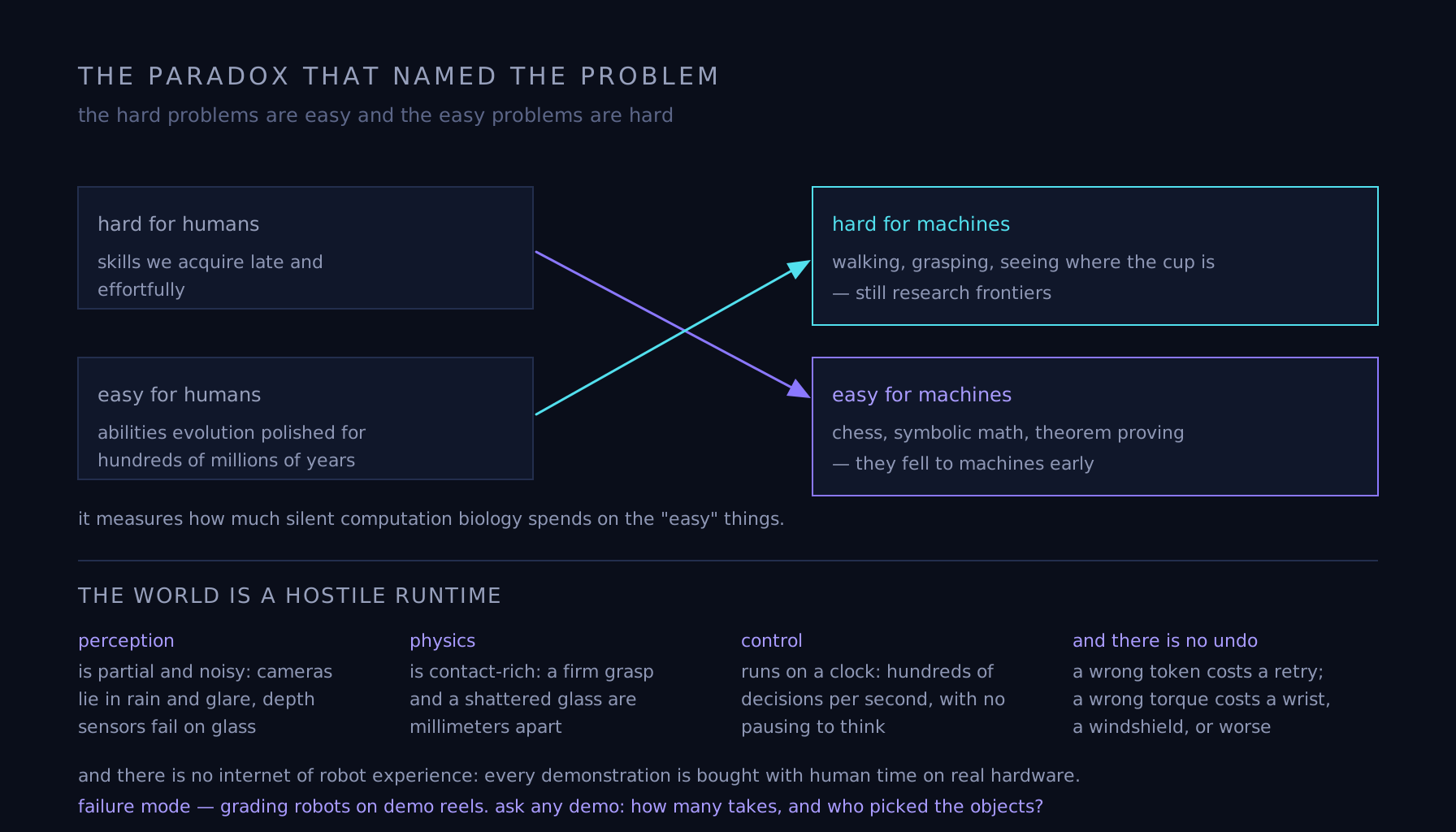
Hans Moravec observed it in the 1980s: the hard problems are easy and the easy problems are hard. Chess, symbolic math, theorem proving — skills humans acquire late and effortfully — fell to machines early. Walking, grasping, seeing where the cup is — abilities evolution polished for hundreds of millions of years and every toddler holds — remain research frontiers. The inversion isn't a joke about priorities; it's a measurement of how much silent computation biology spends on the "easy" things, and it set the field's expectations wrong for decades.
The world is a hostile runtime
Software AI enjoys clean inputs, resettable state, and forgiving latency. A robot gets none of it. Perception is partial and noisy — cameras lie in rain and glare, depth sensors fail on glass. Physics is contact-rich and discontinuous: the difference between a firm grasp and a shattered glass is millimeters and milliseconds, and friction is barely modelable. Control runs on a clock — hundreds of decisions per second, no pausing to think. And there is no undo: a wrong token costs a retry; a wrong torque costs a wrist, a windshield, or worse. Every error category that software AI tolerates, embodiment punishes.
The data famine
The deepest asymmetry is data. Language models pretrained on an internet humanity spent thirty years writing; vision got billions of captioned photos for free. There is no internet of robot experience — no trillion-example archive of torques paired with outcomes. Every demonstration is bought with human time on real hardware, every RL episode risks the equipment, and data collected on one robot may not transfer to a gripper two centimeters different. Robotics' central strategic question is simply: where does the experience come from? Every serious answer — simulation, teleoperation fleets, video of humans — is its own article.
Why optimism returned anyway
Three inputs changed. Recognition effectively works now — a decade of vision progress transferred wholesale, even where the sensors themselves still lie. Internet-scale pretraining gives robots priors about objects, language, and tasks they never physically experienced. And simulation matured enough to mass-produce experience with honest transfer rates. None of this repeals the physics; it changes the economics of learning around it, and the field is moving faster than at any point in its history.
Failure mode
Grading robots on demo reels. A biped's backflip video proves the backflip happened once, under conditions someone chose; it says nothing about the thousandth attempt, the untested floor, or the battery at 20%. Robotics progress is measured in reliability curves and recovery behavior — what happens after the slip — not in highlights. Ask any demo one question: how many takes, and who picked the objects?