History of AI · entry 06/06 · 3 min read
Reading the present
History doesn't predict AI's next act, but it supplies the questions: what rhymes with past bubbles, what's genuinely unprecedented, and which old debates are back in new clothes.
What rhymes
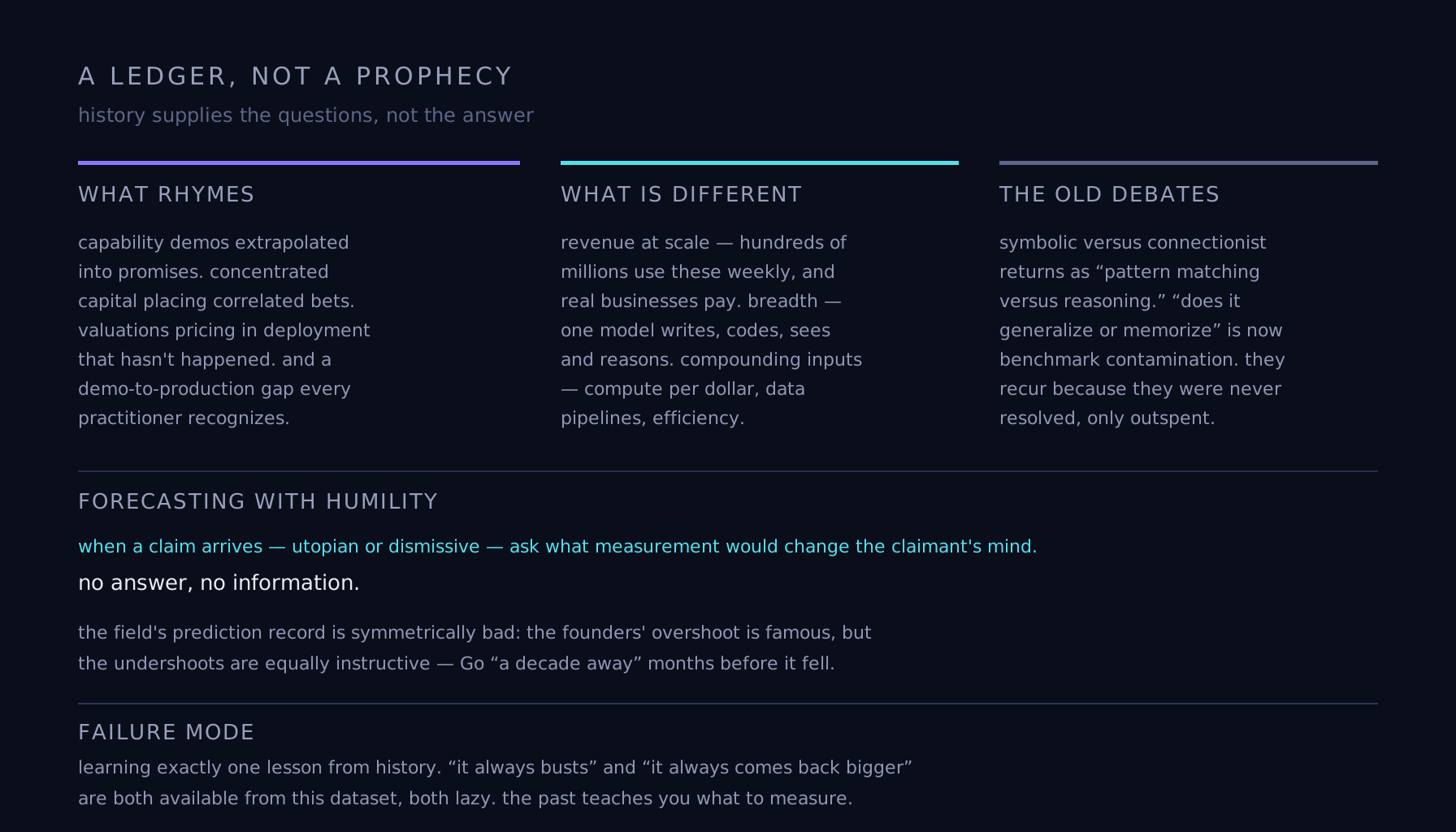
The familiar machinery is running hot: capability demos extrapolated into promises, concentrated capital placing correlated bets, valuations pricing in deployment that hasn't happened, and a demo-to-production gap every practitioner recognizes — agents that dazzle in controlled runs and need supervision in the wild. The winter mechanics are all present. A student of the field's history should feel the déjà vu and say so plainly.
What's genuinely different
Three things past bubbles lacked. Revenue at scale: hundreds of millions of people use these systems weekly, and real businesses pay real money — the 1980s never had a consumer product. Breadth: expert systems did one narrow thing each; one model now writes, codes, sees and reasons across domains, so disappointment in one application doesn't zero the asset. Compounding inputs: the ingredients — compute per dollar, data pipelines, algorithmic efficiency — are still improving on their own curves. A correction could be severe and the technology still wouldn't un-exist; that combination is new.
The old debates, re-armed
Symbolic versus connectionist returns as "pattern matching versus reasoning" — whether next-token machinery can constitute understanding, or needs structured scaffolding. The Lighthill-era question "does it generalize or memorize" is now benchmark contamination discourse. Even the founding conjecture — that intelligence is precisely describable — is still the live wager under every scaling bet. The debates recur because they were never resolved, only outspent; expect them at every capability plateau.
Forecasting with humility
The field's prediction record is symmetrically bad: the founders' overshoot is famous, but the undershoots are equally instructive — Go "a decade away" months before it fell, professional consensus dismissing neural networks the entire time they were becoming supreme. The honest posture is not agnosticism but wide error bars plus attention to measurements over narratives: capability benchmarks, deployment revenue, reliability curves. When a claim arrives — utopian or dismissive — ask what measurement would change the claimant's mind. No answer, no information — and the same test applies to claims about what this is doing to employment, where the evidence is thinner and the confidence louder. Building the habit of checking is its own skill, and building something small is how it stops being abstract.
Failure mode
Learning exactly one lesson from history. "It always busts" and "it always comes back bigger" are both available from this dataset, both lazy, and both regularly wrong at the moment of maximum consequence. History's actual gift is a checklist of mechanisms — funding concentration, benchmark integrity, gap size, input curves — that lets you diagnose this moment on its evidence. The past doesn't repeat or rhyme on command; it teaches you what to measure. Measure it.