Machine Learning Foundations · entry 10/10 · 2 min read
Evaluating models
Accuracy lies, benchmarks saturate, and the eval you didn't write is the failure you'll ship — measurement is where ML rigor lives or dies.
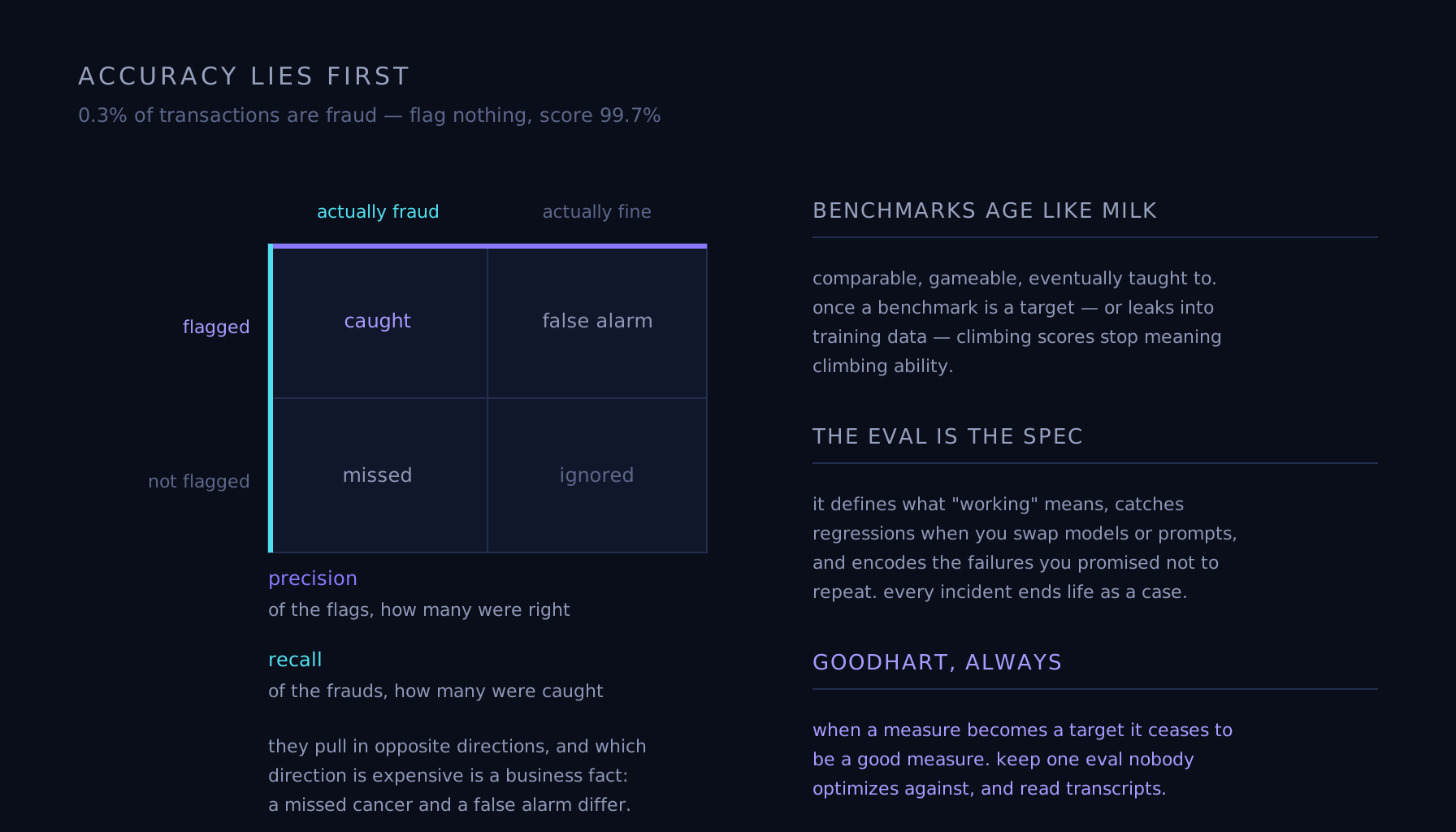
Accuracy lies first
A fraud model that flags nothing is 99.7% accurate when 0.3% of transactions are fraud. Class imbalance makes accuracy a compliment, not a measurement — and an average that hides which group it fails. Precision (of the flags, how many were right) and recall (of the frauds, how many were caught) pull in opposite directions, and which direction is expensive is a business fact, not an ML one: a missed cancer and a false alarm do not cost the same, so no single score can decide for you.
Benchmarks age like milk
Public benchmarks are useful the way standardized tests are: comparable, gameable, and eventually taught to. Once a benchmark becomes a target — or leaks into training data — climbing scores stop meaning climbing ability. Treat leaderboard deltas as marketing until reproduced on data the model provably hasn't seen, ideally yours.
Evaluating generative systems
There is no ground-truth answer sheet for "summarize this contract." The working toolkit: golden sets with rubrics, pairwise preference (is A better than B — humans agree with each other more on comparisons than on scores), and LLM-as-judge, which scales cheaply and inherits every bias the judge has — so it is an instrument that must itself be calibrated before its numbers mean anything.
The eval is the spec
In practice the evaluation set does the job a specification used to: it defines what "working" means, catches regressions when you swap models or prompts, and encodes the failures you've promised not to repeat. Every production incident should end life as an eval case. Teams that treat evals as the product's test suite ship; teams that eyeball outputs ship surprises.
Failure mode
Goodhart's law, always: when a measure becomes a target, it ceases to be a good measure. The model optimizes the metric, the team optimizes the benchmark, the vendor optimizes the demo — three layers of proxy between you and "does it actually work." Keep one eval nobody optimizes against, and read real transcripts weekly; the number is a summary, not the thing.