History of AI · entry 05/06 · 3 min read
The open-weights turn
For a few years the frontier was closed. Then weights started shipping — and a second ecosystem grew with different economics, different politics, and a different definition of 'open'.
How the door opened
The deep-learning decade ran on published papers and, usually, published code. The LLM era broke that habit: as commercial stakes rose — and well before training runs reached nine figures — the strongest models arrived as APIs with a technical report and no weights. The turn was a decision about competition and stated safety risk, not a cost threshold anyone crossed. What reopened it was a series of releases — some deliberate, one famously leaked — that put frontier-adjacent weights in public hands, and the response settled the question of whether anyone would use them. Within months there were quantized builds running on laptops, fine-tunes for a hundred niches, and an inference stack that made "download and run" a single command.
Two ecosystems, not one ladder
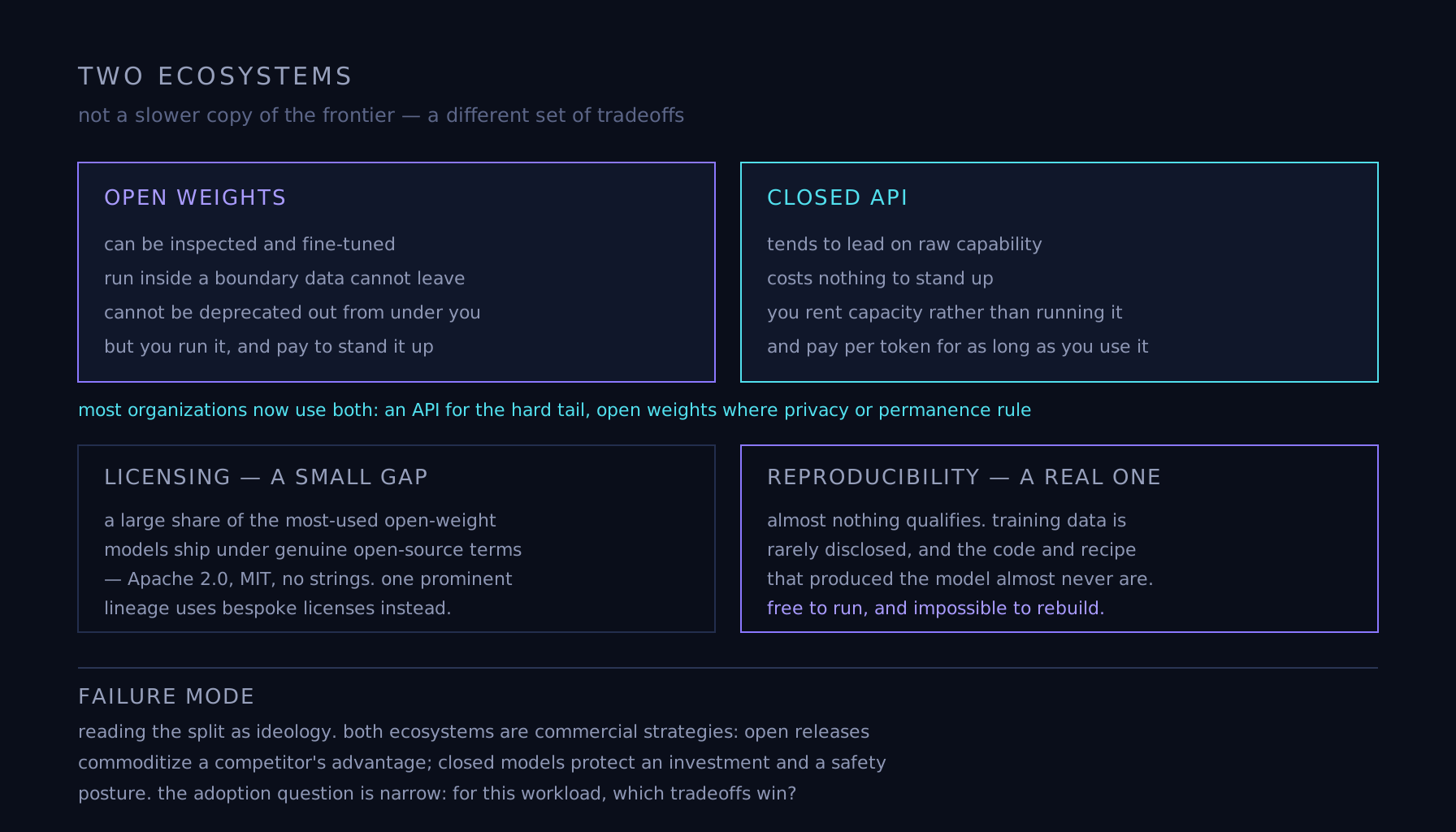
What emerged is not a slower copy of the closed frontier; it is a different set of tradeoffs. Open weights can be inspected, fine-tuned, run inside a boundary data cannot leave, and — decisively — cannot be deprecated out from under you. Closed models tend to lead on raw capability and cost nothing to stand up — you rent capacity rather than running it, and pay per token for as long as you use it. Most serious organizations now use both: an API for the hard tail, open weights where privacy, unit economics, or permanence rule. The gap between the two has narrowed and widened repeatedly rather than closing, and "open models are N months behind" has been wrong in both directions often enough to retire.
What "open" turned out to mean
Two different gaps get collapsed here, and only one of them is real. On licensing, a large share of the most-used open-weight models ship under genuine open-source terms — Apache 2.0, MIT, no strings — while one prominent lineage uses bespoke licenses with acceptable-use clauses and user-count thresholds. On reproducibility, almost nothing qualifies: training data is rarely disclosed, and the code and recipe that produced the model almost never are. So the artifact is free to run and impossible to rebuild. "Open weights" is the honest term, and the gap it names is now a live standards fight — which matters because regulation increasingly writes rules around a category the field has not agreed how to define.
Failure mode
Reading the split as ideology. Both ecosystems are commercial strategies: open releases commoditize a competitor's advantage, build a developer base, and attract scrutiny that improves the artifact; closed models protect an investment and a safety posture. Treating either as a moral position obscures the adoption question, which is narrow and technical: for this workload, which set of tradeoffs wins? That answer changes per workload and per quarter, and anyone certain in general is selling something. The release question is a different one and genuinely open — it turns on marginal risk at a given capability level, not on which camp anyone joined.