Large Language Models · entry 04/11 · 2 min read
Fine-tuning in practice
When prompting stops being enough: how modern fine-tuning actually works — LoRA adapters, data that matters more than volume, and the evals that decide whether you kept what you had.
What tuning is for
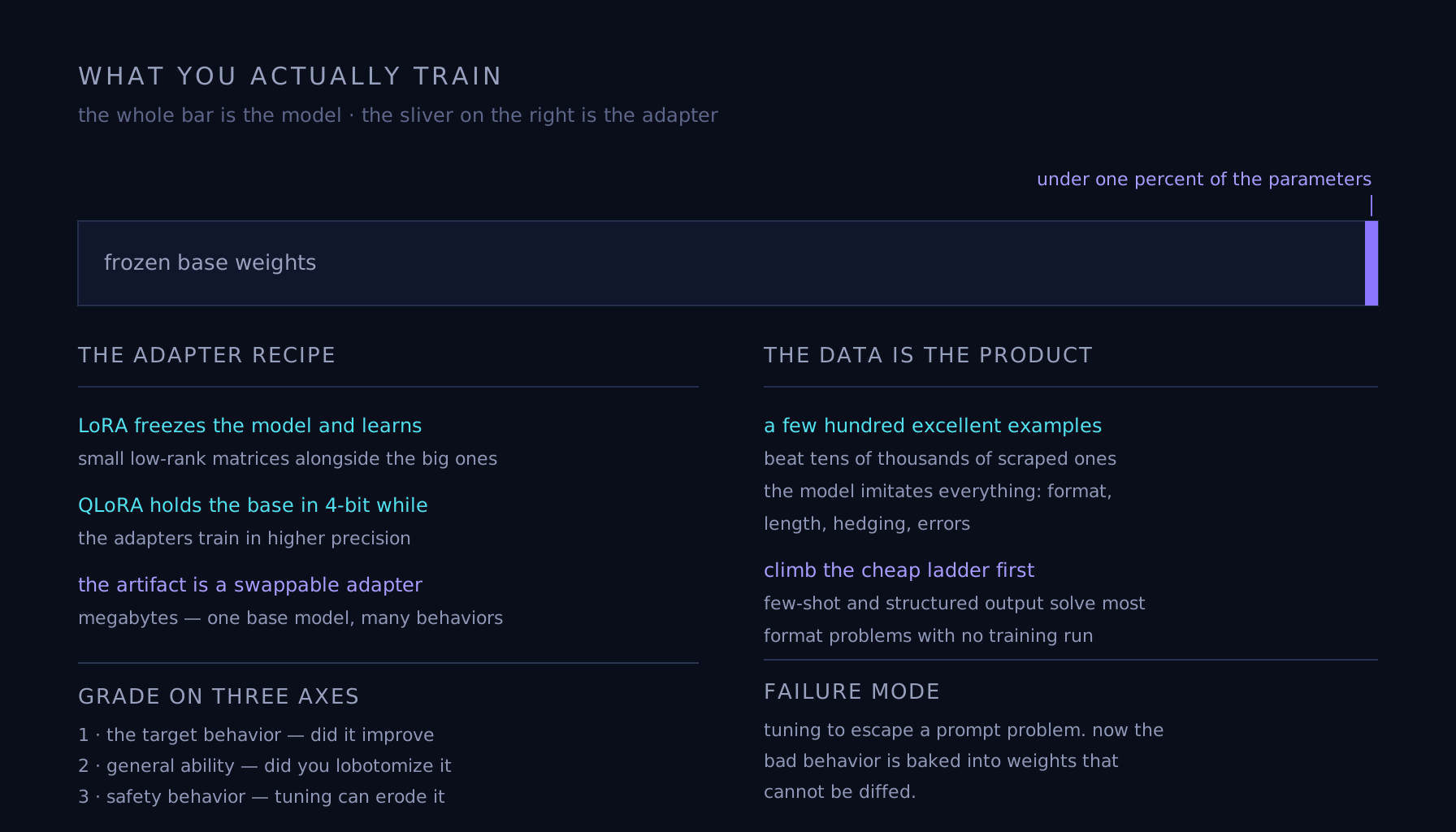
The decision logic lives in RAG vs fine-tuning: knowledge wants retrieval, behavior wants training. This entry is the practice. You fine-tune when a format, voice, or specialty must hold on every response without spending prompt tokens — a strict output dialect, a house style, a domain's vocabulary, a small model imitating a big one's outputs on your task (distillation, the workhorse of cost reduction). Climb the ladder first: few-shot and structured output solve most cases without a training run.
Adapters changed the economics
Full fine-tuning updates every weight — frontier-scale bills, frontier-scale risk. Parameter-efficient methods train a sliver instead: LoRA freezes the model and learns small low-rank matrices alongside the big ones, routinely under one percent of the parameters. QLoRA goes further by holding the frozen base weights in 4-bit while the adapters train in higher precision, which is what lets a serious model tune on one GPU. Quality on focused tasks is usually indistinguishable from full tuning, and the artifact is a swappable megabytes-sized adapter — one base model serving many customers' behaviors. Hosted tuning APIs run the same idea behind a form. The consequential choices are unglamorous: learning rate and epochs (overshoot and the model parrots your examples), and whether your provider lets you tune at all on the model you actually serve.
The data is the product
A few hundred to a few thousand excellent examples beat tens of thousands of scraped ones; the model imitates everything — format, length, hedging, errors. Build the set from real traffic where possible, edited to what the answer should have been; cover the refusals and edge cases you care about, because tuning teaches those too. Then hold out a slice, and grade the tuned model against the base on three axes: the target behavior (did it improve), general ability (did you lobotomize anything — regression on broad tasks is the classic surprise), and safety behavior, which fine-tuning can erode even from benign data. No eval, no verdict.
Failure mode
Tuning to escape a prompt problem. A team burns three weeks on a training pipeline because the model "won't follow instructions," when the instructions contradicted each other — and now the bad behavior is baked into weights that can't be diffed, on a model version that will be deprecated within the year, with a dataset nobody assigned an owner. Fine-tune what is stable, valuable, and demonstrated; keep everything still moving in the prompt, where Tuesday's fix ships Tuesday.